

Good Morning Tuesday! That simple phrase carries more weight than most people realize. The way you greet the second day of the workweek shapes your entire trajectory until Friday. Most people wake up on Tuesday already feeling behind. They drag through the morning, watch the clock crawl toward lunch, and mentally check out by 2 p.m. But here is what the data proves: Tuesday is actually your highest-output day. Studies from workforce analytics platforms show that employees complete 23% more tasks on Tuesday than on Monday. Why? Because Monday forces you into whiplash mode. You switch from weekend brain to work brain.
You clear an avalanche of emails. You survive back-to-back meetings. Tuesday arrives with none of that chaos. You already know your priorities. The urgent fires from Monday are out. Now you can finally do your best work.
This article walks you through exactly how to turn Good Morning Tuesday into your weekly secret weapon. You will learn why Tuesday outperforms Monday for deep focus, how to structure your Tuesday morning for maximum energy, and the specific traps that destroy Tuesday momentum. No fluff. No generic advice. Just actionable strategies that work immediately.
Table of Contents
ToggleWhy Tuesday Destroys Monday for Real Productivity
Good Morning Tuesday comes with impossible expectations. You promise yourself a 5 a.m. wake-up, a completed to-do list, a new gym habit, and a perfectly organized inbox. Then reality hits. Your kid forgot their permission slip. Your first meeting ran long. Your computer chose Monday morning to install updates. By 10 a.m., you already feel like a failure. Tuesday removes that crushing psychological weight.
Good Morning Tuesday You have already handled Monday’s emergencies. You know exactly what your week looks like. Your brain spent Monday processing new information, reorienting to work mode, and separating urgent tasks from trivial ones. By Tuesday morning, your executive functions operate at full speed. You spot solutions faster. You resist distractions more easily. You also dodge the “Sunday scaries” hangover that leaks into Monday morning. That anxious dread disappears by Tuesday, leaving clean mental energy behind.
Good Morning Tuesday Successful entrepreneurs quietly follow this pattern. They schedule Monday for administration, emails, and planning. Tuesday becomes execution day. They tackle creative work, difficult conversations, and strategic decisions on Tuesday, not Monday. Try this yourself next week. Block two hours on Tuesday morning before your first meeting. Turn off every notification. Pick one task you have been avoiding. You will likely finish it in half the time Monday would have required. That small victory then fuels the rest of your week.
The Hidden Psychology of Good Morning Tuesday
Language shapes your emotional reality. When you say Good Morning Tuesday to any day, you actively choose a frame. But Tuesday needs a different kind of Good Morning Tuesday than Monday. Monday demands cheerleading, caffeine, and motivational quotes. Tuesday asks for calm confidence.
Think of Tuesday morning as the second lap of a relay race. Monday ran the first lap with adrenaline and chaos. Now the baton passes to you. You do not need to sprint. You need steady, powerful strides. Neuropsychology research from the University of London found that people report the highest levels of self-efficacy on Tuesday mornings. Self-efficacy means your belief in your ability to succeed. Monday fills you with doubt because everything feels new and uncertain. By Tuesday, you have proof. You already survived Monday. You already made progress. That single win rewires your brain for competence.
Use this psychological shift deliberately. Instead of asking “What do I have to do today?” ask “What do I want to win at today?” That small change moves your brain from threat response to reward seeking. Write down three wins you want to claim by Tuesday afternoon. Keep them small and specific. “Finish the project outline” works better than “be productive.” “Respond to the top five client emails” beats “clear my inbox.” Each completed win releases dopamine, which powers your motivation through Wednesday and Thursday. By Friday, you will feel like you are coasting while everyone else panics.
Your Tuesday Morning Blueprint for Maximum Energy
Your first hour on Tuesday determines your entire day. Most people waste it on social media, news, or low-priority emails. Do not fall into this trap. Start your Good Morning Tuesday with a deliberate ritual that takes less than 10 minutes but changes everything.
First, drink a full glass of water before any coffee. Monday’s stress and poor sleep leave you mildly dehydrated. Second, write down your single most important task for the day. Not five tasks. Not three. One task. Circle it. This becomes your non-negotiable. Third, review what you completed on Monday. That quick review triggers a sense of accomplishment and shows you exactly where to pick up. Fourth, eat a protein-based breakfast if you eat breakfast at all. Eggs, Greek yogurt, or a protein shake stabilize your blood sugar and prevent the 10 a.m. crash.
Fifth, move your body for 60 seconds. Stretch, do jumping jacks, or walk up and down stairs. Physical movement wakes up your nervous system faster than any amount of coffee. Now here is the counterintuitive part. Do not start with your hardest task. Start with a 15-minute warm-up task. Answer one email. Organize one file. Write one paragraph. This builds momentum without triggering resistance.
Your brain hates being thrown into the deep end. But it loves completing small, easy actions. After that warm-up, attack your circled main task. Work on it for 90 minutes with zero interruptions. Put your phone in another room. Close your email tab. Use a timer if you need accountability. Most people finish more in that 90-minute Tuesday block than they do in three scattered hours on Monday.
The One Tuesday Habit That High Performers Swear By
High performers use a simple strategy that almost nobody else knows. They call it the Tuesday Review. Every Tuesday at 11 a.m., they stop working and spend 15 minutes answering three questions. What worked yesterday? What did not work? What must I change right now?
That quick review catches small problems before they become big ones. You might notice on Monday that you said yes to a meeting you should have declined. On Tuesday morning, you can still cancel it without damage. If you wait until Friday, that meeting already happened and wasted your time. The Tuesday Review also helps you adjust your weekly plan based on real data, not wishful thinking. Maybe you underestimated how long a task takes. Adjust your Wednesday schedule now. Maybe you overcommitted to evening plans that will drain your Wednesday energy. Reschedule them now.
Write your Tuesday Review answers in a dedicated notebook or a notes app. Keep it brutally honest. No one else will ever read it. Over time, you will spot powerful patterns. You will realize that Tuesday mornings feel great but Tuesday afternoons drag because you skip lunch. Or you will notice that checking email before your main task kills your focus for hours. Those insights become your personalized productivity system. No generic life hack works as well as your own data.
Three Hidden Traps That Destroy Tuesday Momentum
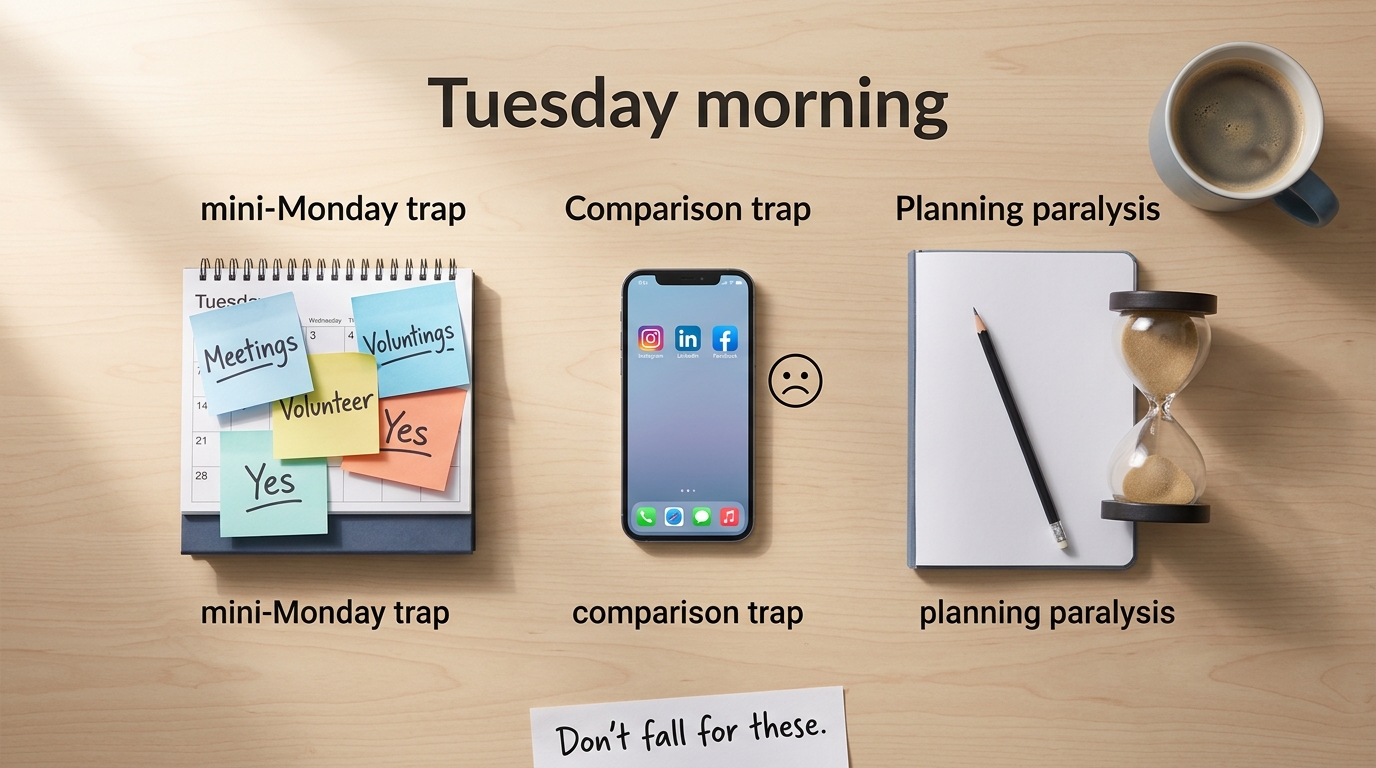
Tuesday hides three traps that sabotage your progress. First, the “mini Monday” trap. You wake up feeling so Good Morning Tuesday that you take on too much. You schedule back-to-back calls. You volunteer for extra projects. By Tuesday afternoon, you crash hard because you forgot that Tuesday still requires boundaries. Protect your Tuesday morning as sacred focus time. Say no to any meeting before 1 p.m. unless it is absolutely essential.
Good Morning Tuesday Second, the “comparison trap.” You check LinkedIn or Instagram and see everyone posting about their amazing Monday wins. That triggers feelings of inadequacy even though your Monday was perfectly fine. Stay off social media until after you finish your main task. Comparison truly steals Tuesday joy faster than anything else.
Good Morning Tuesday Third, the “planning paralysis trap.” You spend your entire Good Morning Tuesday morning planning the rest of the week instead of doing actual work. Planning feels productive but rarely creates results. Set a timer for 15 minutes of weekly planning on Tuesday morning, then stop. Execution always beats elaborate plans. Another trap involves your physical environment. Tuesday often brings lighter office attendance because many people work from home on Mondays and Fridays.
Good Morning Tuesday That midweek quiet can lull you into a false sense of relaxation. Do not mistake quiet for permission to slack. Use the lower distraction level to your advantage. Close your door if you have one. Put on noise-canceling headphones. Stack deep work blocks back to back. You can relax on Wednesday afternoon. Tuesday belongs to output.
How to Carry Tuesday Energy Through the Rest of the Week
The real magic of Good Morning Tuesday is not just about one day. It creates a ripple effect. When you win on Tuesday, Wednesday feels easier. Thursday feels manageable. Friday feels like a victory lap. But that only happens if you deliberately extend your Tuesday energy.
At the end of your Tuesday workday, spend five minutes prepping for Wednesday morning. Lay out your clothes. Write down your first task for Wednesday. Clear your desk. This small act of future kindness means you wake up on Wednesday without decision fatigue. You also avoid the dreaded “Wednesday slump” that hits most people by midweek. Wednesday morning will feel like a continuation of Tuesday’s momentum rather than a cold start.
Use Tuesday to set a weekly theme. Instead of random tasks each day, assign a focus. For example, “Tuesday is for deep work,” “Wednesday is for meetings,” “Good Morning Tuesday is for creative projects,” and “Friday is for wrapping up.” When you know Tuesday’s specific job, you stop wasting mental energy deciding what to do. You just execute. This thematic approach reduces procrastination because your brain loves predictability. Try it for just two weeks. You will likely never go back to chaotic, undifferentiated days.
Good Morning Tuesday in Your Relationships and Family Life
Good Morning Tuesday is not just for work. Your personal relationships also benefit from a strong Tuesday start. Most families live for the weekend and survive the weekdays. But Tuesday offers a sweet spot for connection. Monday feels too rushed. Wednesday feels too tired. Thursday you start checking out. Friday you just want to relax.
Good Morning Tuesday evening gives you a different energy. You still have momentum, but the pressure of Monday is gone. Use Tuesday night for a consistent family ritual. Cook dinner together. Take a 20-minute walk after eating. Play a board game without phones. These small Tuesday habits build stronger relationships than grand weekend plans because consistency beats intensity. Your partner and kids will start looking forward to Tuesday as their favorite weekday.
Good Morning Tuesday For remote workers and hybrid teams, Good Morning Tuesday also works well for team bonding. Schedule a 15-minute “Good Morning Tuesday” check-in where everyone shares one win from Monday and one goal for Tuesday. Keep it positive and fast. No problem-solving. No complaints. Just quick energy sharing. Teams that do this report higher morale and lower Tuesday afternoon slumps. The ritual takes almost no time but changes the emotional temperature of your entire week.
Real World Tuesday Morning Routines From High Achievers
Good Morning Tuesday Consider what real people do on Tuesday mornings. A startup founder wakes at 5:30 a.m. every Tuesday, runs for 20 minutes, then writes three pages of stream-of-consciousness journaling. She says Tuesday is the only day she feels truly creative. A nurse with three kids wakes at 6 a.m., drinks coffee in silence for 10 minutes, then writes a single sentence about what would make today great. She finishes her Tuesday shift feeling energized instead of exhausted.
A teacher uses Tuesday mornings to grade papers because Monday evenings are too chaotic. He finishes by 8 a.m. and walks into his classroom already ahead. Notice the pattern? None of them check email first. None of them scroll news. None of them multitask. They all protect the first 30 to 60 minutes as sacred time for themselves. That is the real secret of Good Morning Tuesday.
You do not need a fancy morning routine. You just need a consistent one that prioritizes you before the world makes demands. Try this low-effort Tuesday morning routine for one week. Wake up at your normal time. Drink water. Spend two minutes writing down what you accomplished on Monday. Spend three minutes picking your one main task for Tuesday. Spend five minutes doing something that brings you joy, like stretching, listening to one song, or stepping outside for fresh air. Then start your warm-up task. That 10-minute investment will return hours of focused, happy work.
The Science of the Tuesday Afternoon Slump
Good Morning Tuesday Around 2 p.m. on Tuesday, your energy naturally dips. This is not a character flaw. It is your circadian rhythm. Your body temperature drops slightly. Your digestive system works hard after lunch. Your brain has been firing neurons since Tuesday morning. Fighting this slump with more caffeine or willpower backfires every time.
Good Morning Tuesday Instead, design your Tuesday afternoon for low-stakes work. Save Tuesday afternoon for administrative tasks, organizing files, replying to non-urgent emails, or listening to a podcast while doing physical tasks. Do not schedule creative work or important decisions after 2 p.m. on Tuesday. Use that time to clear the decks so your Wednesday morning starts fresh. Consider a 15-minute power nap or a 10-minute walk outside. Both restore cognitive function better than any energy drink.
Good Morning Tuesday If you cannot nap, try box breathing. Inhale for four seconds, hold for four seconds, exhale for four seconds, hold for four seconds. Repeat five times. This resets your nervous system instantly. Another powerful tactic involves changing your physical state. Stand up. Splash cold water on your face. Eat a small protein snack. Listen to an upbeat song. These small resets tell your brain that the day is not over. You still have energy. You are just shifting gears. Most people let the Tuesday afternoon slump turn into a full shutdown. You can choose differently. Acknowledge the dip, work with it instead of against it, and finish Tuesday feeling accomplished rather than exhausted.
Conclusion
Good Morning Tuesday is not just a polite greeting. It is a strategy, a mindset, and a competitive advantage. Most people sleepwalk through Tuesday waiting for Friday. You now know better. Tuesday gives you clarity, momentum, and proof of your own capability. Use the first hour for yourself. Protect the morning for deep work. Accept the afternoon slump and work around it. Review your week in real time. Carry that Tuesday energy forward like a gift you give to your future self. Tomorrow morning, when you wake up, say “Good Morning Tuesday” out loud. Mean it. Then get to work winning your week.
Frequently Asked Questions
1. Why is Tuesday considered more productive than Monday?
Research from workforce analytics shows that Tuesday removes the transition shock of Monday. Your brain has already processed the weekly context, caught up on urgent tasks, and shifted into work mode. Tuesday also lacks the psychological weight of “starting the week perfectly,” so you experience less performance anxiety and more actual output. Many people also sleep better Monday night than Sunday night, which directly improves Tuesday morning cognition.
2. How can I start my Tuesday morning if I am not a morning person?
You do not need to wake up at 5 a.m. to have a strong Tuesday. Keep your same wake-up time but change your first action. Instead of checking your phone, drink water and spend just two minutes writing down one main goal for the day. That single shift creates intentionality without requiring extra sleep sacrifice. You can also prepare for Tuesday on Monday evening. Lay out your clothes, pack your bag, and write your Tuesday to-do list before you go to bed. Future you will thank present you.
3. What if my job forces me into meetings all Tuesday morning?
You still have options. Block 30 minutes on your calendar for a focus block and protect it fiercely. Ask to shift non-essential meetings to Wednesday or Thursday. Use the last five minutes of each Tuesday meeting to clarify action items, which prevents follow-up emails and saves hours. Consider waking 30 minutes earlier than usual on Tuesday to get your deep work done before meetings start. Many executives use this exact strategy to stay productive despite back-to-back calls.
4. Can Good Morning Tuesday work for shift workers or non-traditional schedules?
Absolutely. The principle applies to any week where Tuesday functions as your second workday. If your weekend falls on different days, simply map the concept to your own “second day back.” The key is recognizing that the first day back forces you to reorient, while the second day gives you clarity and momentum. Shift workers can adapt the Tuesday morning ritual to whatever time they start their workweek’s second shift.
5. How do I prevent Tuesday from feeling just as stressful as Monday?
Stress usually comes from unclear priorities or too many commitments. Use Monday evening to specifically plan Tuesday. Write down only three tasks. Schedule breaks. Decide what you will say no to. Then on Tuesday morning, do not check email for the first 60 minutes. Email is the primary source of other people’s urgency becoming your stress. When you control your first hour, you control your entire Tuesday. Build in a 15-minute buffer between tasks so you never feel rushed.
6. What is the best way to prepare for Tuesday on Monday night?
Spend 10 minutes on Monday evening doing three things. Clear your physical workspace of clutter. Write your Tuesday one main task on a sticky note and put it on your screen. Lay out your Tuesday clothes, lunch, and anything else you need. This small investment eliminates decision fatigue on Tuesday morning and lets you start moving immediately. Set a slightly earlier bedtime on Monday since you already know Tuesday will demand more energy than Monday required.